
 English
 Español
 Français
 Português
Articles
How to move in the transceiver form factors jungle ?
2 min read

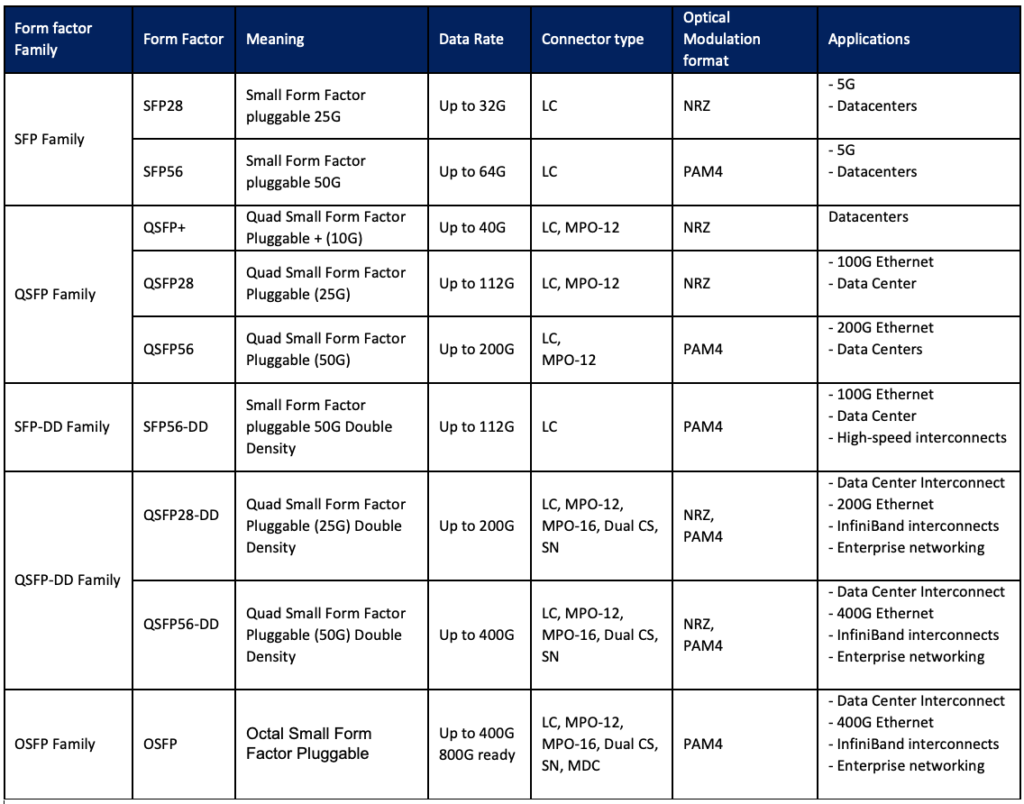
With today's deployment of 25G, 50G, 200G and 400G transceivers, many new form factors are popping up on the market.
The biggest “fight” today is between QSFP-DD and OSFP where both are used today for 200G and 400G applications. They have a number of differences that we will highlight here.
- Size: While QSFP-DD is only a bit longer compared to a QSFP28, the OSFP is 1.5x bigger. In this case, bigger means less port density (36 ports vs 32 ports) but better heat dissipation. Basically, the QSFP-DD equipment will require better thermal management than OSFP equipment since OSFP transceivers already have some thermal dissipation by design.
- Power consumption: The OSFP will be on average < 15W while QSFP-DD will be on average < 12W, which leads to a huge difference when talking about hundreds or thousands of pieces in the field.
- One of the biggest advantages of the QSFP-DD is that its design allows it to be backward compatible with QSFP56 and QSFP28 form factors. Meaning that QSFP-DD equipment will allow the user to fill the port with QSFP28/56 as well as QSFP-DD and make the migration from 100G/200G to 200G/400G easier.
- On the OSFP side, its size allows it to be 800G while QSFP-DD still has some improvement to do before getting ready.
- Coming to 200G/400G, both QSFP-DD and OSFP are using a DSP (Digital Signal Processor) allowing the NRZ modulation to be changed into PAM4 modulation and vice versa. More than that, the DSPs used are able to handle many more modulation formats for the coming data rates.
 Data Sovereignty Begins at the Hardware
 High-Performance Optics for the Memory Crunch
 Celebrating 4 Years as Part of the Amphenol Family
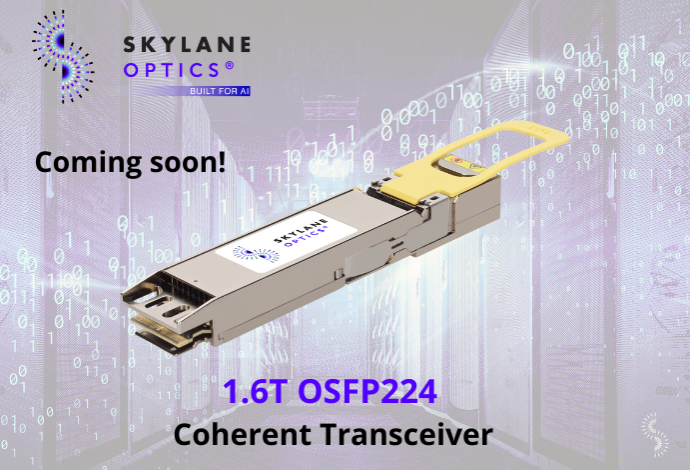 A New Era: 1.6T OSFP224 2xDR4 Transceivers
 Expand Your Optical Network with EDFAMUX