
 English
 Español
 Français
 Português
Case Study: City of Mölndal

City of Mölndal – Skylane Optics
In Mölndal's case the aim was to build a cost-effective and future-proof network with high availability able to support their growth.
Mölndal City is a municipality in the south-west of Sweden with 60 000 inhabitants, interconnecting all the public institutions of the town.
The Challenge:
Mölndal City decided to build out their existing fiber net. The existing fiber net was a 2-fiber ring running on 100Mb/s, and connected the local networks from different municipality premises such as schools, library, health care centers and official buildings. All connected to the head node, located in the city hall.
The drawback in the existing network was the vulnerability. Power failures and other disruptions made the head node lose contact with the other nodes in the network. The existing network also needed to be expanded from about 30 nodes to more than 90 nodes.
The top priorities the municipality had when designing the new fiber infrastructure were: Redundancy, Scalability, Cost.
The solution CWDM:
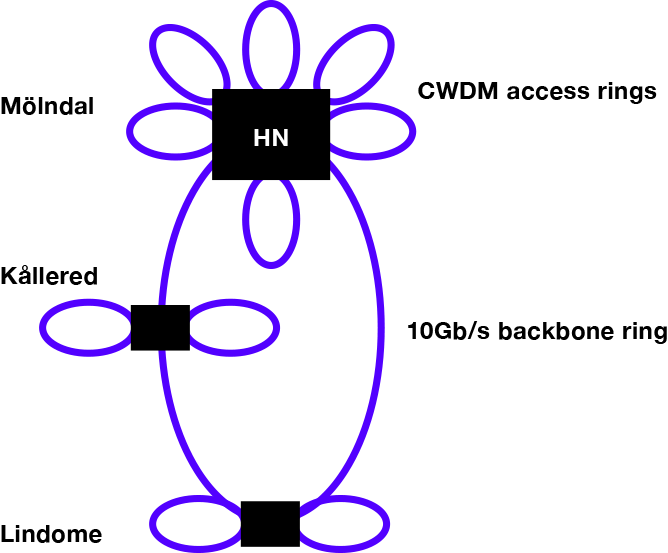
The solution was to use the CWDM technology. This enables several nodes to use the same fiber and thereby save cost. To have scalability and growing possibilities, the network was designed as a 10G backbone ring and from this ring expand several CWDM rings at the 3 major sites: Mölndal, Kållered and Lindome.
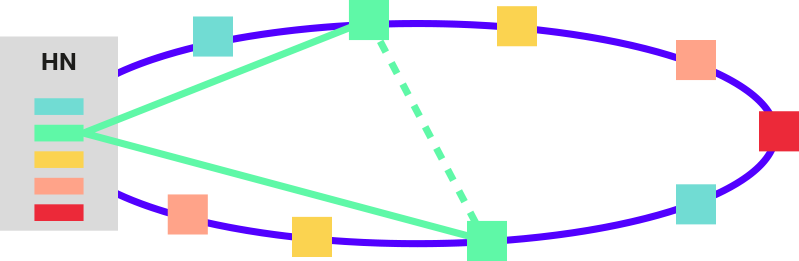
Each CWDM ring has not more than 12 nodes. By having two nodes in each ring using the same wavelength, expected infrastructure is reach in a logical level. The picture below shows a sketch of a ring with 9 nodes, using 5 wavelengths. The same wavelengths are repeated a maximum of twice in the ring; this creates good redundancy and regenerates the optical signal.
Components used:
Switches
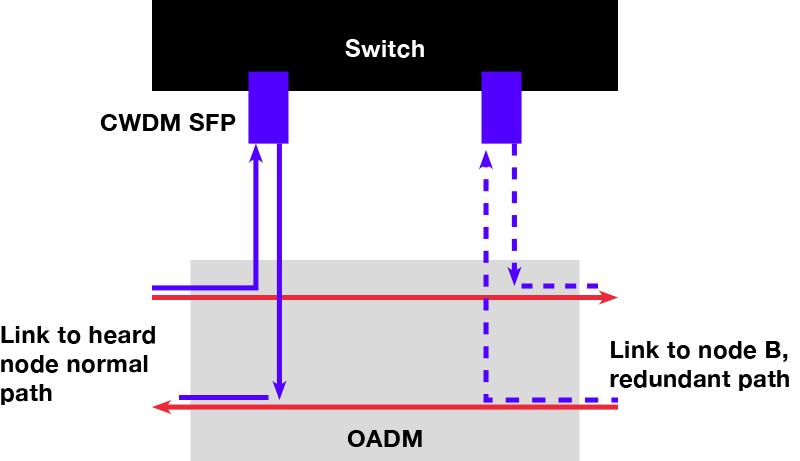
This network was achieved by using standard switches. The switches have been configured to handle the redundancy and the monitoring of the network. The switch turnover time for the network is 50ms. As for the monitoring, the alarms are sent as SMS to the employees of the municipality IT department.
Pluggable optics
SFP, Small Form-factor Pluggable, is the optical transceiver type used in most switches today. For this network, standard 1Gb/s CWDM SFPs from Skylane Optics® were used. To take into account the attenuation in the add-drop nodes the 80km version with a link budget of 32dB was used, even though the diameter of the rings was less than 80km.
Filter
The CWDM technology is enabled by using a multiplexing unit, Mux/Demux, combining all wavelengths at the head node and a one channel Optical Add Drop Module, OADM, at each node. This was supplied by Skylane Optics®. The filter units are totally passive devices using no electricity, so they are not affected by power failure.
The Benefits
The experience of Mölndal is that the proposed CWDM solution has been working extremely well. They had some interruptions in the network in the first month after deployment but as they had redundancy built into the network this never affected the end customer. They are very satisfied to now have full control over their own network, not being dependent on a service provider. The high capacity of the network enables the IT department to upgrade or re-install the computers in the network remotely, giving efficient IT support. As a next step Mölndal will now build out their network with 30 more nodes.